
Loading
Loading
When the United States rolled into Baghdad in 2003, taking down Saddam Hussein’s regime, the military leadership in Tehran looked at it with existential panic. Saddam’s massive conventional military evaporated the moment its central command went dark. For the Islamic Revolutionary Guard Corps (IRGC), the lesson was to avert a situation where a single point of failure can render the entire institution useless.
When the United States rolled into Baghdad in 2003, taking down Saddam Hussein’s regime, the military leadership in Tehran looked at it with existential panic. Saddam’s massive conventional military evaporated the moment its central command went dark. For the Islamic Revolutionary Guard Corps (IRGC), the lesson was to avert a situation where a single point of failure can render the entire institution useless.
What followed was a fundamental overhaul of Iran’s defense architecture. Beginning around 2005 under Mohammad Ali Jafari, Tehran abandoned central control in favor of what is called mosaic defense. The country was carved into 31 provincial commands, each equipped with its own intelligence apparatus, its own voluntary domestic security apparatus of the IRGC called the Basij, and pre-delegated authority to act independently if communication with Tehran severed. Fast-attack naval craft and ballistic missile assets were dispersed into subterranean networks. To survive an enemy with overwhelming air power, Iran built a hydra.
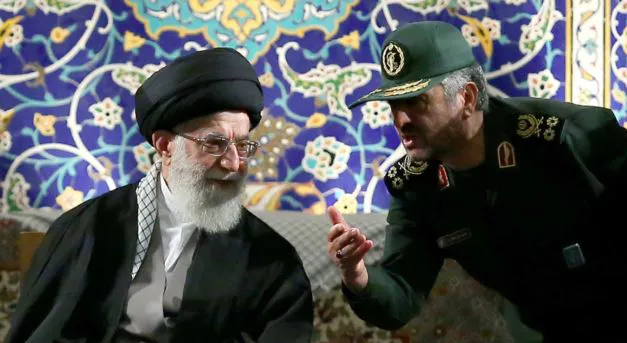
Ayatollah Ali Khamenei (left) with Mohammad Ali Jafari (right), the former commander of the Islamic Revolutionary Guard Corps (IRGC)
We are now witnessing the efficacy of that design. The doctrine was built to deter foreign invasion and crush domestic dissent simultaneously. By integrating the Basij directly into provincial IRGC units, Tehran ensured that the exact same commanders tasked with launching asymmetric anti-access/area-denial (A2/AD) warfare against an incoming fleet were also empowered to put down an uprising on their local streets.
With respect to the current conflict, the model has proven resilient. When June 2025 air strikes eliminated IRGC chief Hossein Salami, the machine didn't pause. When subsequent joint U.S.-Israeli strikes decapitated the top tier of the regime, killing Ayatollah Ali Khamenei alongside his defense minister and key military chiefs, the expected paralysis never materialized. Instead, provincial commanders executed standing orders, launching retaliatory strikes across the Gulf without waiting for a replacement in Tehran to sign off.
Mosaic defense functions as an instrument of attrition rather than a vehicle for decisive victory. The very decentralization that renders Iran impossible to defeat swiftly also renders a war exceedingly difficult to conclude. As Henry Kissinger contended in Diplomacy, genuine victory and durable peace require a state to command unified authority, such that political strength can translate military force into clear strategic outcomes. In Iran’s case, once forward operating bases are destroyed, isolated regional commands can neither project unified power, replenish advanced precision weapons, nor execute coordinated large-scale maneuvers.
This stalemate, however, need not culminate in Iranian defeat, and may in fact operate to its advantage. The primary concern is the asymmetry of stakes where for Iran, the conflict is existential, and mere survival implies victory, whereas for the United States, if it prolongs the war, it risks losing out on other priorities.
Washington would consider China, rather than Iran, as the principal long-term challenge to American power. The Chinese, thanks to their ability to enhance trade with countries, have gained significant traction amongst countries in South East Asia, particularly in Indonesia, Malaysia, Thailand and Vietnam and the preservation of a favorable balance in the Indo-Pacific would demand the assets that a protracted Gulf campaign would consume.
A prolonged conflict would also cause a cost asymmetry, as Iranian drones, mines, and rockets cost a fraction of the systems required to neutralize them, so that each engagement imposes a disproportionate burden on the defender. Concurrently, instability in the Strait of Hormuz would drive up oil prices and shipping insurance costs worldwide, generating considerable pressure on Washington to pursue de-escalation.
Finally, Gulf partners exposed to Iranian retaliation, together with allies burdened by energy shocks, may urge the United States toward a negotiated settlement. Taken together, these pressures could compel Washington to deprioritize the conflict in favor of its larger strategic commitments, enabling Iran to prevail not through battlefield triumph but through sheer endurance.
Politically, the strikes that resulted in decapitation did not dismantle the Islamic Republic, but rather, merely accelerated its transition into a military junta. With Khamenei gone and his successor Mojtaba remaining largely out of public sight, the civilian and clerical guardrails have dissolved. Power has consolidated around the hardline IRGC veterans, namely, Mohammad Bagher Ghalibaf, Mohammad Baqer Zolqadr, and Ahmad Vahidi. By removing the one figure the Guards were bound to obey, the strikes effectively handed the keys of the state to the generals.
Negotiating with this fractured apparatus is a diplomat's nightmare. Diplomatic channels are choked by paranoia and messages are handwritten and carried by couriers for fear of signals intelligence breaches, while Iranian negotiators stall because they must build consensus among its provinces. Worse still, delegated authority creates immense risk of accidental escalation. A rogue naval commander in the Gulf operating on standing orders could easily sink the wrong flag vessel, triggering an escalation ladder that no one in Tehran has the centralized authority to climb down from.
Meanwhile, the Iranian public bears almost the entire cost of this endurance. The rial has slid to historic lows, and the Guards are spending their remaining resources fighting insurgencies in the borderlands. Thus is the paradox at the heart of the Hydra strategy, where a doctrine built to outlast foreign enemies depends on the patience of a population that is growing exhausted. If the Islamic Republic falls, it is more likely to crumble from within than be defeated by external forces.
The lessons Tehran learned from Baghdad have perhaps worked and decapitation hasn’t really meant defeat but has instead left a dozen autonomous fires and without a head, it has no single voice to negotiate with and no clear path back to peace.